
Inside Roblox Studio: Creators Discuss Working in Unique Art Styles
We Sat Down With Four Creators to Talk About Building Beautiful Games on Roblox

What does a Roblox game look like? At one point, that was a relatively easy question to answer—and even now, there’s a certain “look” that probably comes to mind when people think of the platform.
But Roblox today isn’t the same as 15 (or even five) years ago. It’s a full-fledged game engine. It’s capable of re-creating the same blocky style that millions of players around the world fell in love with, but it’s also capable of realizing a vast array of completely different visions, depending on the developer.
A grounded and tactical shooter. A scientifically accurate rendering of Southern California, 25,000 years in the past. A fantastical land of magical monsters struggling to survive. All of these games were made with Roblox Studio, using the same tools available to all creators on the platform.
“We often get comments from people saying, ‘I can’t believe this is Roblox,’” said Bavelly, who re-creates and animates realistic animals for prehistoric survival game Ecos: La Brea. We’ve all had these moments, and they’re fun and surprising—even inspiring. But we envision a future where people instead react with “Of course that’s on Roblox,” where developers use Roblox Studio to power a whole range of artistic styles, from blocky to photoreal and everything in between. This visual diversity is what we hope to champion with our Jumpstart and Incubator creator programs, and you can see the early results from our first Incubator cohort.
Last week, we launched a Terrain Early Access Program, giving creators a first look at new tools to customize terrain, alongside streaming and LOD improvements, unlocking the ability to create massive open worlds without the need for cross-server teleports. It’s an exciting launch, and we have a full technical breakdown on DevForum. But we also thought this launch would serve as a great excuse to talk about what Roblox Studio is capable of, and to talk with some of the teams using it in groundbreaking ways.
Blank Slate
Here’s what Roblox Studio looks like when you open it for the first time:

It’s a familiar sight for every Roblox creator—but it should also look familiar if you’ve ever developed a game in any modern 3D engine. To reiterate a point we made earlier: Roblox Studio is a full-fledged game engine, with the tools and capabilities to match.
Some Roblox creators choose to work in a blocky style with saturated colors, in part because it is relatively easy and approachable. But many creators have started exploring what else is possible in Roblox Studio, and we are constantly adding features to help them push the boundaries.
We sat down with the developers of popular Roblox games Frontlines, Creatures of Sonaria, and Ecos: La Brea to discuss what it’s like working in Roblox Studio and which features they’re most excited about. We also chatted with Fluorlite, who uses Roblox Studio in a completely different fashion—pushing the engine’s graphical capabilities just to see what’s possible, without worrying about making a finished game at the end.
Frontlines and Frontlines Versus
Developer: MAXIMILLIAN


“Can we build a AAA game that downloads in 10 seconds?” That’s the question that drives Clarence Maximillian, the creator behind fast-paced shooter Frontlines and its follow-up, Frontlines Versus.
The original Frontlines began development in 2017. Maximillian partnered with just a single other developer to create the prototype that, a few years later, turned into Frontlines, a fast-paced military shooter with realistic visuals. This was followed by Frontlines Versus, which built on its predecessor but added reflective materials, higher-quality models, more bespoke art assets and maps, and more.
“On the first Frontlines, we really just wanted to see if high fidelity was even possible,” said Maximillian. “For Frontlines Versus, we doubled down on our learnings. And for our next open world project, we’re going to push it even further. Let’s see how far we can push it.”
For Maximillian, fidelity is all in the details. “There are a lot of tutorials that can teach you how to create a game, but there are very few people that really care about the tiny details, and when you emphasize a lot of the small things, it adds up to a larger thing.” He cites sound design in Frontlines as an example, saying that one team member spent six months working on weapon audio and how it bounced off different surfaces.
“We’re not really focused so much on making the highest-fidelity game possible, but on how players feel—and how we feel—when playing our games.”
Relived, The Jungle Hollow Showcase, Stormy Heights Showcase
Developer: Fluorlite


At the opposite end of the spectrum is Fluorlite, who now works full-time on environment art at Twin Atlas but is mostly known for creating jaw-dropping showcases on Roblox, i.e. works of art that are built solely to show off visual fidelity, not to be played.
“Around 2016, I found this game that really inspired me, called Clouds,” said Fluorlite. “That was the first time I had ever seen something on Roblox that wasn’t just Baseplate with whatever gameplay mechanic, but actually something that was trying to tell a story, something that was trying to give some emotional interest to the viewer, and that is what really got me into creating artworks on Roblox, rather than just creating games.”
Fluorlite has created dozens of stunning showcases since: towering cathedrals, rain-swept cliffs, arid deserts, a lava-lit cave, and (most recently) a lush jungle. “I make my assets in Blender and other software, but composition and set dressing and all that, I do natively in Roblox Studio,” he said.
Creator Store—Studio’s built-in repository of community-sourced meshes, plugins, and more—has been particularly helpful for Fluorlite’s work.
“Creator Store has a lot of great open-source stuff that other creators have made,” said Fluorlite. “That’s where I would mainly pull from in my early days. I was only 11, 12, 13 back then, so I wasn’t too familiar with texturing software at the time. And I think that’s what makes Creator Store so great—that somebody as young as myself, and as unknowing as myself back then, was still able to create some cool stuff.”
Even now, Fluorlite is quick to tout the work done by other talented Roblox creators that help make his showcases possible. “The plugin dev community is just amazing,” he said, name-dropping the plugin Redupe. “Basically, if you have a group of parts or a group of meshes in your workspace, you can dynamically scale those or rotate those at different degrees and increments. It almost felt like it was procedural models before procedural models came out.”
Procedural models is the bleeding-edge Roblox Studio feature that Fluorlite is most excited about. “It’s like being able to think out of my head directly into Roblox Studio, just because of how accessible it is—being able to do lines of ornaments, fence posts around walls, rocks around roads, and having models that snap to where I want them.”
Fluorlite is experimenting with procedural models for his latest showcase, which is actually a rework of an earlier scene, updated with all of the tech that Roblox Studio has added in the ensuing years. “The main thing has obviously been 4K [textures]. I’ve put 4K on everything, which is probably a jump scare for most engineers that are working with me,” he said, laughing. “So 4K, emissive maps (for fire and lava), and custom material variants for terrain. Those three things have been really, really huge.”
Though he’s now working full-time on games, Fluorlite still loves showcases and the community that built up around them, name-dropping Roblox Architects and Elite Builders of Robloxia as two groups that inspire him to keep pushing the boundaries on Roblox Studio. “Seeing all of those creators—it is a little thing that I keep in the back of my mind, to maybe compete with their stuff,” he said. “I would definitely say I’ve grown alongside the platform as an artist.”
Creatures of Sonaria
Developer: Twin Atlas
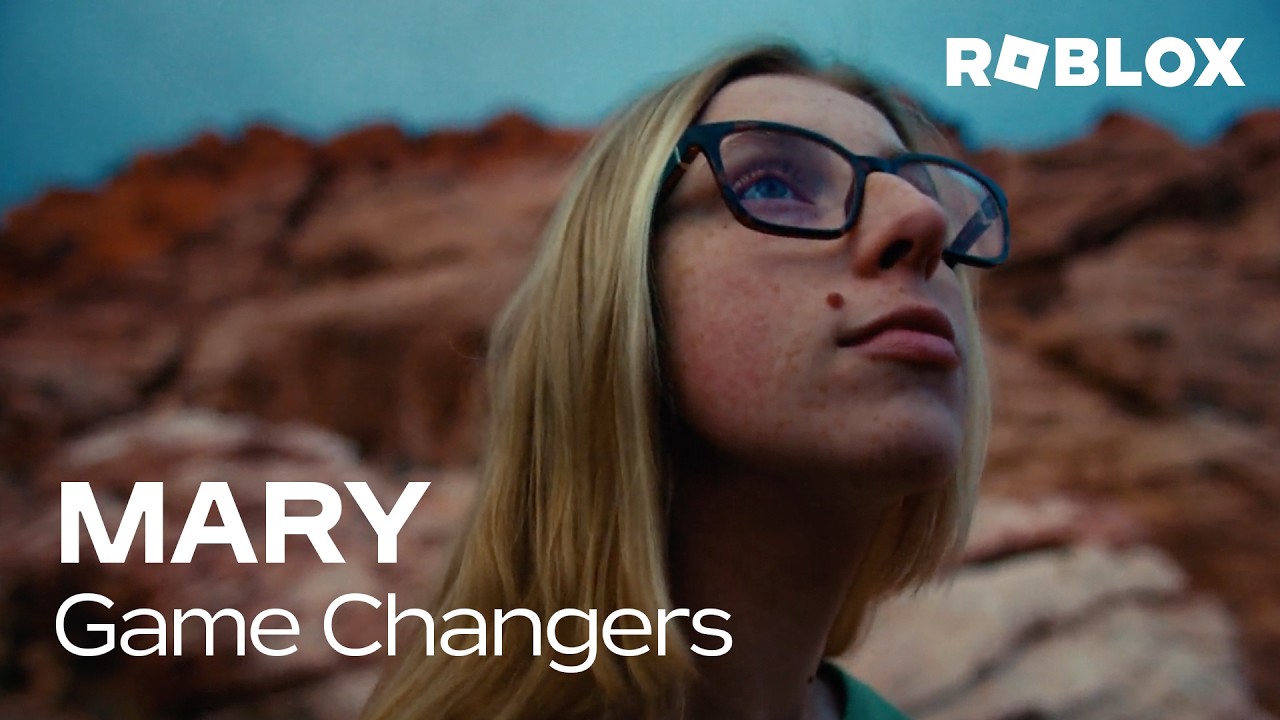


“We’re boundary pushers. We want to see how much we can push the limits,” said Mary Rukavina, Director of Creativity at Twin Atlas and the creator of ambitious survival game Creatures of Sonaria.
Set in a sprawling open world split into multiple biomes and packed with fantastical wildlife, Creatures of Sonaria was an early example of creators building bigger and more dynamic environments on Roblox. It was so big and so dynamic, in fact, that an early incarnation of Creatures of Sonaria ran into Roblox’s memory limits.
“Roblox was like, ‘Why is your game so big?’” said Rukavina, laughing. “We were like, ‘Okay, maybe we need to reel it in a bit.’”
One major change Twin Atlas made was to use instance streaming to dynamically govern how Creatures of Sonaria loads from the server, based on what players see. “We realized that our map was 99 million cells, which…that’s a lot of different things for players to load, especially mobile players,” said Rukavina. “We carved up the map from the bottom to reduce how many terrain cells players were loading, and we got it down from 99 million to about 25 million.”
The titular creatures in Creatures of Sonaria also presented a challenge. Each creature might look like a single entity in-game, but under the hood they’re made up of hundreds of small components, all bonded together. “First we model a creature in Blender. Then, we have our modeler chop it up into all these segments to make sure that it can rotate and be animated in the way that we need it to. Then we take this sectioned rig, and we export it into Roblox Studio, and use local Roblox plugins to actually connect the entire creature together, giving it bones and making sure that the rotations look good,” said Rukavina.
“We were able to make the game smaller by changing our meshes to hull—generalizing the shape of a mesh,” Rukavina continued. “For instance, rather than a really complex set of antlers defined by specific meshes, we turn that into a hull—sort-of a balloon surrounding the shape.” This simplifies collisions, while preserving an aspect of the game that players love: They can customize the color of creatures on a per-mesh basis, as Creatures of Sonaria uses Roblox’s built-in Color and Material properties instead of textures.
“Because we’re using the local Roblox Colors and Materials, when Roblox released Surface Appearance, we were able to get some really cool materials in the game,” said Rukavina. “And with emission maps now, we have leveled up the visuals of some of our projects tenfold.”
Rukavina teased that her next project is going to push Roblox’s boundaries, just as Creatures of Sonaria did at release. “We’re exploring mesh deformation and pushing the boundaries there, and the character colors as well,” she said. “You can have some really awesome-looking characters with glowing and translucent and reflective skins.”
“I think knowing where the boundaries are helps us to push them further,” Rukavina continued. “Every single game I want to design is literally the craziest game idea ever, and we ask, is this even possible on the Roblox platform? I love how easy it is to create inside Roblox, and I just feel like I’m not done here yet.”
Ecos: La Brea
Developer: Ecos Team


For prehistoric survival game Ecos: La Brea, the pursuit of scientific accuracy led toward photorealism. “We wanted to accurately represent a real place and let people experience that,” said Zack, who does environment design (and more) on Ecos: La Brea. “We’re all very science-focused—we appreciate nature for what it actually is, instead of trying to improve upon it.”
Ecos: La Brea is set in the Southern California of 25,000 years ago, and the team—which boasts a geologist, a zoologist, and more—wanted to re-create the environment of the time, from the scrub brush and trees to the pig-like peccaries, saber-toothed cats, mammoths, and other creatures that roamed this lush landscape.
In part, Ecos: La Brea grew out of a feature added to Roblox Studio a few years ago. “When Roblox changed to have mesh rigs—that was a big reason why we decided to start a new project, to work with those,” said Mev, Lead Programmer and Gameplay Designer.
Modeling the wildlife of prehistoric California is an intricate process. “I tend to look at CT scans—online repositories of scanned skeletons—and reconstruct the skeletons myself,” said AJ, Senior Modeler on the project. “Then we can model the soft tissues and flesh on top of the skeleton. It’s very sculptural.”
The team also draws on animals that are still alive to inform its view of the past, a field called comparative anatomy. “We’ll reference how Asian elephants move because they’re the closest analog for mammoths. For saber-toothed cats, we look at tigers and jaguars—seeing how those animals move and behave and applying it to the behavior of another,” said Bavelly, Animation & Design Manager.
“When we got PBR [physically based rendering] support, that was an absolute—I mean, no pun intended—game changer for me,” Bavelly continued. PBR models how light interacts with different materials, enhancing the look of fur, bark, and other details. “Our textures were able to become so much more photorealistic. I’ve personally been very surprised by what Roblox Studio can handle, and how lifelike things appear.”
Equal attention is given to the environments that creatures inhabit in Ecos: La Brea. “California today is very dry, but 25,000 years ago, it was more humid. Water was a much bigger part of the landscape. There would have been a lot more trees and wetlands,” said Shaun, Modeler and Environment Designer. The team even sought advice from a paleobotanist at the real-life La Brea Tar Pits in Los Angeles, who suggested that the Monterey cypress would’ve been highly prevalent in the era depicted. “Showing that to audiences gives them a perspective into how the world works on larger timescales,” Shaun continued.
For aspiring creators, Jumpstart applications remain open. We’re supporting and mentoring creators as they build their dream games, and we are always looking for talented people with great ideas.
Check out the DevForum as well for technical details on the Terrain Early Access Program, including new customization tools and streaming improvements.


